
Why Interstellar’s Biggest Plot Hole Isn’t Actually A Plot Hole
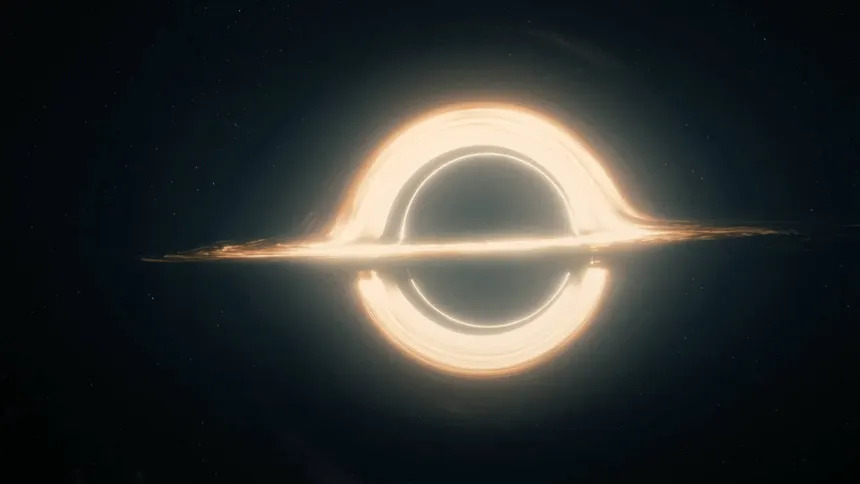
More than a year ago, I watched Christopher Nolan’s Interstellar because it was my birthday. Even though I’d seen it a thousand times, even though critics complained of a serious plot hole, I always find myself going back now and again to re-experience what I once did in 7th grade, in the theaters. This time, after talking with my dad and sister for an hour-long post-movie conversation, I realized something.
It’s not a closed time loop.
I’m going to assume you’ve seen the movie, but fine, here’s your SPOILER WARNING anyway.
When the movie first came out, critics slammed it in part due to one big plot hole: If Cooper was Murph’s ghost, how did he see the ghost in the first place? It’s the same as the grandfather paradox: if I go back in time and kill my grandpa, then I would be erased, because my grandpa is the reason I exist. Therefore, if I am erased, then there is no one to kill my grandpa, and then… see, it hurts just to think about. As much as I loved the movie, I had to admit defeat and confess that part didn’t make sense.
Another thing that always confused me about the movie was why they said the “aliens” or that mysterious race that created the “time library” as I call it, were 5th dimensional. Huh? Why’d they skip the 4th dimension? I never figured it out. Not only until multiple rewatches, years and years later. The answer isn’t simple, but the puzzle pieces clicked together.
They made a mobius strip out of time.
It’d be easier for you to look up a mobius strip yourself, but the idea is that you take a strip of paper, twist it once, meet the two ends together, and that’s a mobius strip.
That’s the gist of my theory, but stick around if that’s not enough for you. What I want is to explain the methodology as best I can, starting around the theory of dimensions themselves. This is not my theory at all, and it’s possible I’ll make a mistake, so I want to tell you: relax. If you can’t relax, there’s a comment section below.
The first dimension is a line. It has length, so exactly one dimension. Nope, no width, no depth, just a straight line. So the first dimension can be imagined as an impossibly thin needle or piece of string, because it’s not “thin” at all—it has absolutely zero width.
The second dimension is a flat plane. Two dimensions: length and width. The second dimension is best described as a single piece of paper.
So the third dimension, which is what we are, has length, width, and depth. Three dimensions. The paper of the second dimension becomes a book in the third dimension.
There’s a pattern we have here: the first dimension is a line; the second is a piece of paper; the third is a book. My assertion is that this trio (lines, paper, books) continues onwards into higher dimensions.
The fourth dimension is where it normally gets tricky, because this is something our brains cannot properly observe. But if we go back to dimensions as measurements, then we can assume the fourth dimension is time. That’s a huge leap, obviously, but that’s the measurement that seems to fit into place. Volume is more of a third dimension thing. Energy, or heat, seems a bit closer, but that’s something observable. Weight is another decent shout, but because we can properly measure it rules it out for me.
Time is (probably) the fourth dimension, the fourth measurement. And by proxy, time is also the measurement used in the fifth and sixth dimension. If you’re not on board, fine, get off, let me have fun. Think about it, though, all our measurements of time are completely arbitrary. Time is based on how many times the earth rotates: around the sun and around its own axis. Clocks run on the decay of caesium.
All we know is that there is a before, a now, and an after. Our understanding of time is linear. Wait. Did you catch that? Linear. Time is a line. Kind of like the first dimension. So if 1, 2, & 3 establish a pattern, 4, 5 & 6 continue it.
The 4th dimension is a line, so that must mean the 5th dimension is somewhat like paper, and the 6th dimension is somewhat like a book. And then, by that same pattern, that means 7, 8, & 9 follow a similar pattern. And then 10, 11, & 12… ouch my head.
Before we all go insane trying to even think about that, let’s stop at the 5th dimension, because this is why I wanted to make the point in the first place. If the 5th dimension is paper, then could it fold? Could it bend? Could it perhaps become a mobius strip?
Interstellar seems to think so. When Cooper goes into the black hole and appears in that “time library,” the suggestion is that this mysterious race of 5th dimensional beings, which later are revealed to be future humans, managed to take him there to change the past. The reason why it works is because they managed to bend time.
The moment Cooper is sucked into the black hole is the moment when the mobius strip connects. So Cooper’s perceived timeline appears to loop, but the mobius strip means that there was only ever one path, it just had some twists and turns.
But how does one twist time? How did the future humans even survive the famine? Woah, woah. I only promised to solve one plot hole, I didn’t say I wouldn’t create new plot holes!
If I were to weasel my way out of these new plot holes, I would say that humanity is capable of amazing things. In 1903, less than seventy days before the Wright brothers flew the first vehicle, a New York Times writer said it would take humanity “one to ten million years” to develop a flying machine. The worst thing anyone can do is quit, say something is impossible, or do anything besides keep on trying.
No responses yet